

Microbes, Hawaiian Lava Tubes, and Life on Mars
We discovered a new genus of species living in Hawiian lava tubes—an important finding when looking for life in similar lava tubes on Mars.
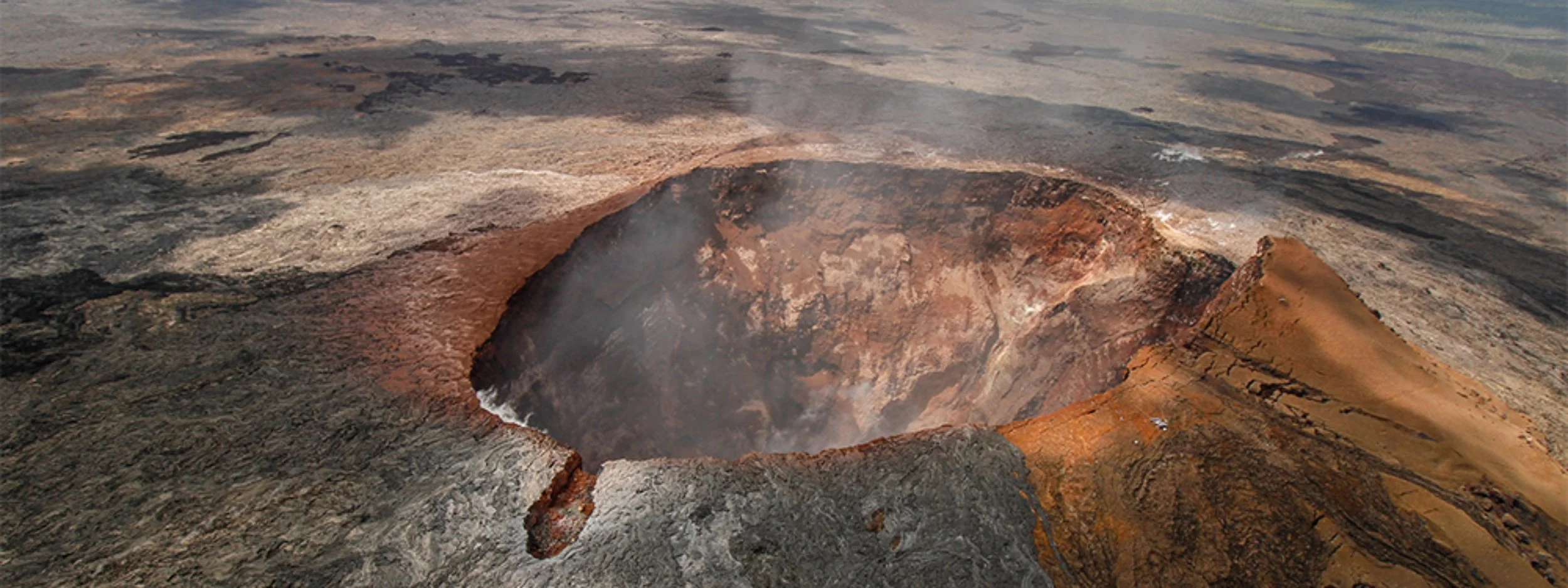
Volcanic Developments, Pink Rocks & New Species
Lava tubes, natural channels formed by flowing volcanic lava, are of special interest in the search for life on other planets. They occur on other planets besides Earth, and their basaltic walls provide protection from radiation and harsh conditions that otherwise make surviving and thriving anywhere other than Earth a challenge - even for microbes.
We worked alongside collaborators at Georgetown University and the National Aeronautics and Space Administration to study microbes living in lava tubes beneath Mauna Loa, Earth’s largest active volcano.
We found a surprisingly high degree of niche partitioning over small spatial scales - meaning that competing species in lava tubes tend to partition resources or space in their niche to exist cooperatively. Based on recent bioinformatic advances in metagenomics, we assembled dozens of high-quality genomes (including those from several novel species!).
Our work was the first to combine 16S SSU rRNA sequencing and whole genome shotgun sequencing to map the microbial diversity and functional potential within a Hawaiian lava tube. Samples taken just centimeters apart revealed significant differences in community make-up, with implications for how to assay a region of interest on Mars.
In addition, the unique metabolism of a new genus discovered here provides a glimpse into the microbial communities in volcanic habitats and how they may evolve with limited nutrient availability in these extraordinary, martian-esque settings. Siliceabacter maunaloa was identified presumably for the first time in pink, gypsum-rich mineral deposits within lava tubes with direct sun exposure. Metabolic inference analysis suggests the microbe itself may contribute to the pinkish colour of the mineral deposit!
Read more here: https://agupubs.onlinelibrary.wiley.com/doi/full/10.1029/2022JE007283

Surveying Oceanic Microbial Communities
Microbial communities in oceanic Oxygen Minimum Zones (OMZs) that are integral to marine ecosystem health are currently facing disruption.

OMZs, a Growing Concern
Microorganisms in oceanic oxygen minimum zones (OMZs) are vital for nutrient cycling and ecosystem health. In a study presented at the 2018 Ocean Sciences Meeting, we harnessed the microbial data with bioinformatics to reveal intricate relationships within these vulnerable microbial communities that are facing disruption due to the OMZ expansion that is a direct consequence of warming global temperatures.
We used a pathway-centric approach to analyze microbial community metabolism in the expanding northeast subarctic Pacific Ocean OMZs. Using a powerful bioinformatics pipeline, we analyzed data collected at various stations along the Line P transect, stretching from Saanich Inlet on Vancouver Island to open ocean station “Papa”.
Our analysis uncovered a rich story of delicately balanced microbial communities sharing resources with their neighbours - from sunlit to dark, oxygenated to oxygen-starved, energy rich to energy poor OMZ neighbourhoods, all on the edge of climate change-driven disruption. The metabolic activities of the communities we studied have a profound influence on ecological and climatic balance, and ongoing deoxygenation of these waters due to rising temperatures and changes in ocean circulation could push these ecosystems past a critical point.
Read more here: https://agu.confex.com/agu/os18/meetingapp.cgi/Paper/323897

Life Beneath the Ice of an Antarctic Lake
A glimpse into life on distant planets? - We’ve discovered microscopic life beneath Antarctica's ice sheets, a place similar to environments in space.

Alien Worlds On Earth?
Amidst 70 quintillion planets in the cosmos, does Earth truly stand alone as the sole source of life? In a pioneering partnership with the National Aeronautics and Space Administration, we've unearthed thriving microscopic communities beneath Antarctica's ice sheets, offering a glimpse into life's potential existence on distant, oxygen-starved oceanic worlds.
Biological methane production may be possible on extraterrestrial ocean worlds such as Enceladus, the sixth largest moon of Saturn. We studied the chemosynthetic pathways used by life in the isolated, perennially ice-covered Antarctic Lake Untersee - an analog to such an extreme environment - for the 2019 American Geophysical Union Fall Meeting. We analyzed water and benthic sediment samples from Untersee, whose light-starved, near-freezing anoxic zone is one of the most methane-rich aquatic ecosystems on Earth.
The presence of methane in this lake, where no seepage occurs, suggests a biological origin; our bioinformatic analysis of these samples, which revealed the presence of methanogenic archaea and the complete methanogenesis pathway, supports this conclusion. As the conditions under which these organisms and metabolisms are thriving could exist on extraterrestrial worlds, our findings have far-reaching implications for the search for life beyond the confines of Earth.
Read more here: https://ui.adsabs.harvard.edu/abs/2019AGUFM.P24A..04W/abstract